A Thousand Words: xXx: State Of The Union

xXx: State Of The Union

One of the few comparative advantages that books have over visual media in the spectacle department is that huge feats can be added with no extra cost. The time and money spent on an author writing something is, for most intents and purposes, the same whether the author is writing a nonviolent office romance or a baseball third baseman fighting evil Georgists on the moon.

The flip side is that this makes most thrillers hard to actually adapt. Only the most successful can get movie/TV adaptations, and those have a bunch of risks. Smoothed out, they have many changes. Enter xXx: State Of The Union, the movie that most accurately shows the spirit of the most ridiculous “airport thrillers.”

The original xXx, starring Vin Diesel, was considerably worse. That was a period piece dated immediately in the “90s X-Treme” area (despite being released in 2002). This sequel, starring Ice Cube, manages to transcend all of that. You have stormtroopers in futuristic masks participating in an American coup attempt. You have a tank battle on board an aircraft carrier. You have a finale where a car’s tires are deliberately ripped so it can go on train tracks (where of course it fits perfectly).

Somehow it all added up so that this one and only representation of the craziest cheap thrillers ended up getting on the screen with a budget that did it justice. Something with this exact blend of “amazingly stupid” and “stupidly amazing” very rarely comes around. And that it is why, in spite of all its many, many faults, I just love this movie.
Review: 38 North Yankee

38 North Yankee

Ed Ruggero’s debut novel, 38 North Yankee, tells the story of an American infantry company in a Second Korean War. It has its issues, but works a lot better than his later book, Firefall. That had a ridiculous setup it didn’t need. This is more grounded and plausible.

Ruggero’s legitimate veteran status both gives the book a degree of verisimilitude and makes it diverge too often into Herman Melville territory.  Most of the “box checking” elements are done right. There are viewpoint characters but not too many. There are things that realistically go wrong. Unlike John Antal’s significantly worse Proud Legions, he doesn’t overemphasize the important of the main character’s unit. This is one of the most grounded “big war thrillers” I’ve read.

However, it also has the weaknesses of being grounded. The viewpoint jumps and the over-detail (including maps) clashes with the fog of war inherent in such thing. And by aiming for the plausibility it does, it sometimes stumbles into the trap of “military action can be written in a plausible or engaging/exciting way , but it’s very hard to do both.” It’s a problem that neither writers of truly serious fiction nor Mack Maloney have, but which something of this nature does.

That being said, none of these are deal-breakers and the book is very much worth a read. It might be the best Second Korean War novel I’ve read, even more than Red Phoenix.

Another (but similar) opinion can be found on the Books That Time Forgot blog.

Review: The Book Of Basketball

The Book Of Basketball

I’ll be honest, The Book Of Basketball was one of my favorite sports books, as fit someone who grew up reading Bill Simmons’ web columns. Now it looks worse in hindsight. And I don’t mean the tasteless jokes.

The secret about Simmons is that his difference from the stuffy old sportswriters is and was a matter of style, not substance. There’s the same focus on the capital-N Narrative, the “he’s got that clutch spirit” eye test, and the sort of only-a-sportswriter-can-see-it “intangibles” that aren’t talent anyone can see or statistical/tactical analysis an expert can. It’s just dipped in sleazy jokes and pop culture references.

The not so-secret part about him is his unashamed Celtics fandom. This ranges from harmless (much of the description) to mildly annoying (ranking Celtics high and then clumsily placing Magic Johnson and Kareem Abdul-Jabbar ahead of Larry Bird to go “see, I’m not biased-see”) to the seriously flawed (Having an entire chapter devoted to excoriating Wilt Chamberlain while praising Bill Russell).

The opinionated history of the NBA section is funny, somewhat informative, and really well-written. It should have been stretched to the then-present, instead of, say, the sections complaining about the MVP award and the abominable “Russell, then Wilt” chapter. There’s the inevitable “Of course a surviving Len Bias would have been a legend and not the kind of Christian Laettner/Danny Manning-esque player who’s great in college but merely good by pro standards” section.

Then there’s the Hall of Fame Pyramid, where his concept of the best 96 players of all time, from Tom Chambers to Michael Jordan are listed. It’s a fun but obvious attempt to have the cake (see, it’s a logical ranking-a formal ranking) and eat it too (“This guy knew The Secret [a banal “teamwork” cliche Simmons tries to pass off as profound], I don’t need numbers”). Take a combination of Simmons’ previous antics and an obsession with winning championships (and not the kind of obsession an actual player or even a fan understandably has, but a specific “I’d rather be Robert Horry [7 titles] than Charles Barkley [0 titles]” statement) and the result is not that good.

The anecdotes are often well-done, but lose their power when submerged in a combination of inconsistent use of stats (Simmons goes from fluffy “stats” like total All-Star appearances to an overimpressed Thomas Friedman-esque reaction to advanced stats to the sort of “You can’t measure heart”-style quotes that the likes of Fire Joe Morgan would rightfully tear to pieces), and the cliches. The Team Player against the Selfish Greedy Superstar, the man who can rise to the occasion and grab the ring vs. the man who just doesn’t have it in him. This Manichean writing is dinosaur sports commentary at its worst.

This book feels like a long-range two pointer, inefficient and outdated. There are some good moments, just like how there are still justified long two shots. But, with a decade of hindsight and a more open mind, there’s more bad than good here.

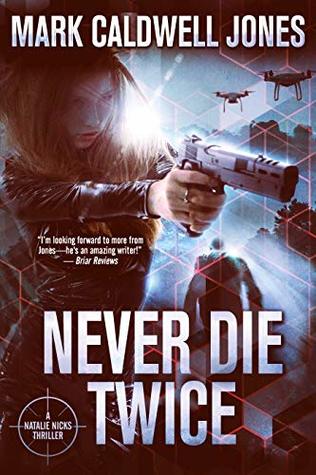
Review: Never Die Twice

Never Die Twice

ndtcover

Mark Jones’ Never Die Twice is the first book in the Reaper Force: Viper series, detailing the adventures of cybernetically enhanced heroine Natalie Nicks. With short chapters and simple prose that reminded me of Sidney Sheldon of all people, it’s not the most technically adept book. Even by cheap thriller standards.

What it is, however, is a fun book. It lands on the sci-fi end of the technothriller spectrum, with a lot of “just barely sorta a little kinda maybe slightly plausible” technology. I’ve used the “homemade apple strudel” analogy before to describe something that you know isn’t the most well constructed, but is still quite enjoyable. And this definitely fits the bill. I mean, the book has a line about pitting humans against grizzly bears in races. Its backstory is basically that of The Bionic Woman. What’s not to like?

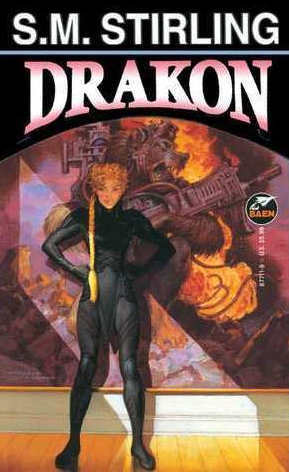
Review: Drakon

Drakon

drakoncover

The fourth book in the Draka series, Drakon is the story of the Draka utterly triumphant, having bioengineered humanity into master and servant subspecies-in one universe, with only the descendants of those who escaped the “Final War” to stand against them. Too bad homo drakenis Gwendolyn Ingolfsson got sucked through a wormhole experiment into the then-present. She plots to take over the world for the Draka, with only a strange cast of people from multiple universes to stop her.

This isn’t really alternate history, even in the most fleeting sense. It’s pure cheesy science fiction, a “fight the Terminator-Predator-Amazon” story. Drakon is as sleazy as it’s cheesy, with Stirling never missing a chance to throw in a lurid detail. And while it works as a turn-your-brain-off “51% book”, there are some legitimate and serious flaws.

First, it doesn’t have, say, Jon Land’s sense of buildup. Too much is revealed too fast, and the residual baggage of the alternate history background burdens it even more. Second, the conclusion is an utter clunker. That is to say, it’s a simultaneously confusing and rushed mess of escalation that ends with a contrivance and ridiculously obvious setup for a sequel that understandably never came. Third, the only interesting character is Ingolfsson herself, and even she could be done a lot better.

Take away the fandom controversy and the legitimately distinct (however dubious) alternate history that made up the first three installments, and all you have is, as I’ve said before, tawdry fiction that, while not unreadable or unenjoyable, wouldn’t really stand out.

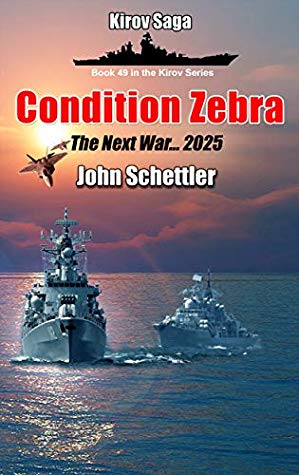
Review: Condition Zebra

Condition Zebra

conditionzebra

The (supposedly) final arc of John Schettler’s epic Kirov series, now exceeding even The Subspace Emissary’s Worlds Conquest in terms of word count, begins with Condition Zebra. This is the story of a contemporary World War III, after the Kirov timeshifted away from another contemporary World War III, possibly making it the first series to have multiple World War IIIs in it.

Having read two books in the 49-and-counting series, I figured it would at least be the same as before.  I was wrong. It somehow managed to be worse. And it manages to be worse in ways that might be considered contradictory at first glance.

One one end, the basic nuts and bolts writing has all the problems of the past Kirov books (characters who exist solely to operate military equipment, rote technical descriptions of the battles that give away the wargames used to sim them, and overall clunkiness) and just feels sloppier, with the dialogue, grammar, and even structure seeming worse.

On the other, the giant timeline tangles get bigger, more confusing, and somehow more pointless-seeming than ever. Knowing the end result and purpose, it just feels like the developers of Madden, 2K, or The Show making up a gigantic plot about time machines and time-traveling team general managers to explain why past players can appear in a game with current stars.

Maybe it’s those above flaws and maybe it’s just that the novelty of seeing the world’s longest wargame let’s play has worn off after three books, but this doesn’t even seem bad in a bemusing way anymore. It’s just bad.


Review: Howling Wilderness

Howling Wilderness

The sourcebook Howling Wilderness sets the basis for the remaining North American setting in Twilight 2000.

I feel that in an isolated spherical cow world, the North American modules of Twilight 2000 should have been a different setting, something like “Apocalypse 2000”. It would probably be a good idea to alter the rules so that the out-there adventures can be a lot more viable. But theme alone would be enough to make the switch.

There’s two literary problems with actually keeping it and the original European setting part of the same universe. The first is the creative regression. The European setting is a clever way to square the circle of “Ok, we want you to be in the army but we also want you to be able to run free. We’ll make this post-apocalyptic, but not too post-apocalyptic, since we still want there to be tons of those tanks around.” There are still flaws, and not just the impossibility to balance dark struggles for survival, rivet-counting crunchy gaming, and traditional RPG adventure that all appear in the rules.

Enter this, where the setting is more of a traditional post-apocalyptic one. North America has been crushed by a mega-drought and everyone has withered down. This leads to the second problem, which is how this led to gimmicks. It feels like the setting should be doubling down on the “grim survival” element, but then an individual sourcebook has a submarine plot right out of Jerry Ahern’s Survivalist, making things more muddled than ever.

I don’t blame GDW for releasing new content out of business necessity. I also think that, given the flexibility GMs have for actually running games, the negative effects of any official supplement are inherently limited. But I still feel that, like how the Survivalist jumped the shark post-timeskip, Twilight 2000 also jumped post Atlantic crossing.

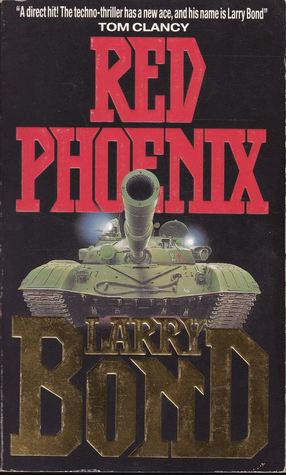
Review: Red Phoenix

Red Phoenix

redphoenixcover

Larry Bond’s Red Phoenix, telling the story of a second Korean War, is something I’ve struggled with for a while but now, after a lot of other books read, have the words to successfully describe. In short, it’s the Marine Force One of “big war thrillers”.

Every archetype of the small genre is there. The shifting viewpoints from top to bottom. Going into every part of the theater. And so on. And they’re executed with enough skill to not be bad, but not enough to be truly memorable or standing out.

What does stand out, and which I also have a more nuanced view of than I used to, is the long intro setting up the war. I’ve thought it, from a literary perspective, to be less than ideal. It’s taking a huge amount of effort to set up something the reader already knows will happen.

But from a plausibility perspective, given the massive unlikelihood of a Second Korean War even at the height of the north’s power, I can forgive it for putting in the effort to set up a situation where it could happen. It’s certainly better and less ridiculous than Cauldron at any rate.

And what else is there to say? This is very much a “if you like the genre, you’ll like this book. If you don’t, you won’t” kind of novel.

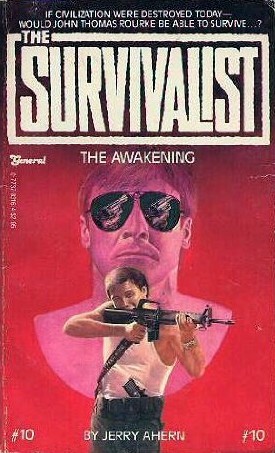
Review: The Awakening

The Awakening

awakeningcover

The tenth Survivalist book, The Awakening is when the series changes significantly. Having spent centuries in suspended animation to ride out a world-consuming fire wave underground, the Rourkes now emerge to take stock of the changes and aid the space-launched Eden Project as it prepares to return. John Rourke ages his children by selectively thawing and refreezing them so that they can be the same age as the adults when they wake up, and they emerge into a world where human life still exists.

This book, if I had to reedit/adapt the Survivalist series, probably wouldn’t even exist at all. I’d probably fold the recovery and the Eden Project return into an epilogue to Book 9 at worst and a few extra chapters at best, and then conclude the series there. But in actual history, the books were selling enough to continue and Ahern finally had the ability to make them more and more science fiction-y.

While the Survivalist series was never a “hard” setting to begin with (after all, the nuclear war caused multiple states to tumble into the ocean), here begins an even more contrived setup. There was an underground shelter. And another underground shelter. And another underground city. And an underwater city! It’s very much like a Bethesda Fallout game where there’s a lot of conveniently working stuff laying around centuries after the war, and it becomes a more obvious author’s toy with each new book after this.

(Later there will be a second timeskip that will obliterate the last traces of any post-apocalyptic residue in the setting, but that’s another story)

The actual book itself is more satisfactory Jerry Ahern action, but this is still the time when the series jumped the shark.


Review: The Council Of Ten

The Council Of Ten

counciloftencover

Jon Land’s The Council Of Ten is a thriller that starts off with the impression of being overly mundane. Launching with the obvious Miami Vice-inspired tone and location, the book starts slowly and there’s a fear of just being a slightly eccentric drug novel. Thankfully, the super-conspiracy reasserts itself, the Big Burly Bad Guy Thug appears, and soon all is right with the world.

It’s incredibly hard to review a lot of similar books by one author. The Council Of Ten is a little subpar by Jon Land standards. The MacGuffin not living up to some of the more ridiculous ones isn’t really too bad. Worse is that there’s a little too much space devoted to long and comparably mundane fights. But it still has all the wonderful craziness Land is known for, and, after its slow introduction, it never feels like a rote 51% book.

And besides, you’ve gotta give props to a book that has a conference room on its cover.