Review: Lions of the Sky

Lions of the Sky

lionscover

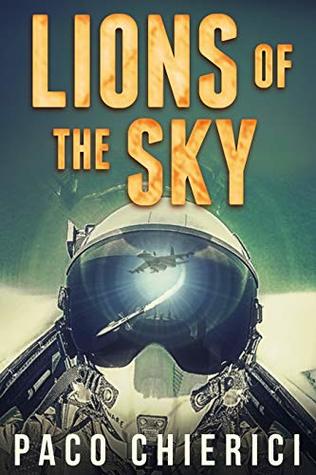
The F/A-18 centric Lions of the Sky is naval aviator Paco Chierici’s first novel.

If I was to make a comparison, I’d say it’s like a modern version of Sweetwater Gunslinger 201 with a few more technothriller elements thrown in. Or, to use a less obscure pop culture reference, a modern version of Top Gun in print form with somewhat higher stakes.

I’m willing to forgive a lot of the roughness in a first novel, especially if I ultimately still found it enjoyable (which I did). Yet I feel obligated to point out that it is indeed there. The problem is that the sum of the parts seem like more than the whole. In particular, the entire “Spratly Islands Technothriller Plot” that winds in and out through the book is the least interesting part of it. What went through my mind as I read every section involving it was “it didn’t need to be like this. To set up the final action set piece, there doesn’t need to be a stakes-raising gimmick like what happens here.”

Beyond that, it doesn’t flow the best. There’s no real exact way to describe it and it’s clearly just the rough edges every first novel has, but the slightly clunky pacing is still apparent.

When the actual aircraft action scenes occur, they’re well written. Many of the on-the-ground relationship scenes are also well written. There’s definite talent here, and I hope, if/when Chierici completes any more books, he plays to his strengths and makes it a little more coherent in one direction or another. Lions of the Sky itself isn’t bad by any means, but it still feels like just a decent orange dish that has a few apple slices awkwardly stuffed in.

Review: The Eighth Trumpet

The Eighth Trumpet

Kimberlain_Jared1

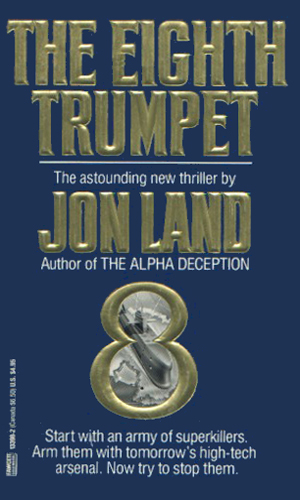
Fresh off the first Blaine McCrackens, Jon Land introduced fellow super-agent Jared Kimberlain for a similar absolutely bonkers thriller. The Eighth Trumpet not only has offbeat fight scenes, it also has a plot centered around an, uh-Jerry Ahern-ian grasp of geography. By this point the formula has solidified, especially with the Hulking Strong Sidekick Protagonist who fights the dedicated Hulking Strong Antagonist hand to hand during the climax.

That being said, it manages to out-McCracken even some of Land’s other books with how ridiculous-and fun- some of the set pieces are. It’s not that much different “plot”-wise from many of Land’s other books (at least to someone like me who has actually read a ton of them), but it definitely has a huge spark of “WOAH!” in it, making it very worthwhile.

Review: Shadow Tyrants

Shadow Tyrants

shadowtyrantscover

Deciding to try my luck with grocery store novels, I grabbed Shadow Tyrants, a “Clive Cussler’s” book written with Boyd Morrison. It was an Oregon Files novel, and it followed my rule of “go for the most out-there premise.” This had infighting amongst an ancient conspiracy, with only the Oregon and Juan Cabrillo able to stop them. What could go wrong?

The biggest problem is the prose. It’s not unread-ably bad, but still comes across as kind of simple and bland. Thus a premise that could have supported a delightfully goofy adventure ends up being hobbled and coming across as a 51% technothriller. (Although the super-conspiracy is still better and more capable than Casca’s Brotherhood ever was-those guys are the St. Louis Browns of super-conspiracies). There’s headline namedrops and clear “I know the name but not much else” descriptions of weapons systems.

There’s a lot of contrived deus ex machinas in close proximity to each other. I’d be more forgiving if the prose had cushioned it, but it instead amplified them. For instance, what could have been a excellent naval battle (the best use of the Oregon) ends up being just a disappointing clash of the technothriller gimmicks.

Worse, the “historical tie-in” seems even more forcefully shoved in. It’s not like the superweapons had an ancient component. It’s just that these ancient scrolls led to the super-conspiracy, and we get a shoved-in epilogue to remind us that Cussler books are supposed to feature grand adventures with historical artifacts, not just be middling technothrillers piggybacking on his reputation. Unfortunately, that ship sailed decades ago.

This is still a good enough “51% technothriller”, and it’s still more engaging and fun than just a rote “shoot the terrorist” thriller novel. But it, much like a lot of the other Oregon books, doesn’t live up to its potential.

Review: Advance To Contact

Advance To Contact

advancetocontactcover

In the early stages of Fuldapocalypse, I reviewed Andy Farman’s Stand To, a World War III tale. Or rather, a sleazy spy tale that became a World War III tale that involved everything I thought I’d be seeing en masse on Fuldapocalypse, and then some. Lots of descriptions. Lots of viewpoint characters. Lots of meticulously described battles.

Now I’m in one of those full circle moods. I still had the remaining books in the series left unread, so I decided to return to that mostly untapped World War III vein and read the second Armageddon’s Song book, Advance to Contact.

Farman has had decades of legitimate expertise as a soldier and police officer, and indeed the infantry fighting scenes in this book sometimes actually work. The key word here is “sometimes”. Often they blur together (since the characters are so forgettable and interchangeable). Often Farman fills it with infodumps on the exact levels of equipment and/or author lectures on whatever topic is technically relevant. Often the viewpoints are yanked away and yanked back. Often they’re overdescribed to the point where it loses its focus. Still, I should give legitimate credit where credit is due. There’s one scene with doomed Belarusian soldiers where he actually writes well, doesn’t get too infodumpy, and keeps the ‘camera’ focused on them instead of jumping a continent away after a few paragraphs.

Another instance of deserved credit is that the plotting and pacing is a little better than in Stand To. The war is underway, so the goofy spy plot is less prominent and the viewpoint jumping merely at the level of “exaggerated technothriller” rather than the wrenching shifts of Stand To.

That being said, it still has most of the problems mentioned over a year ago in the review of Stand To. The times when details are gotten wrong (given the ridiculous amount of description) are annoying. Farman doesn’t focus on where he’s most skilled and comfortable but instead gives giant air/sea battles. There are bizarre events like B-2s being used as tankers and Tu-160s as special forces insertion craft. The dialogue for anyone not in the military is frequently awkward. And the pacing is just glacially slow.

Still, like with the first book, I couldn’t feel mad about this and frequently felt amused. This is an earnest series by a first-time fiction writer. It’s just that what could have been at least a rival to Chieftains with some more focus turned into this clunked-together technothriller kitchen sink.

Snippet Reviews: October 2019

The Press Gang

Kenneth Bulmer (as “Adam Hardy”) wrote the Fox series of age-of-sail adventures in the 1970s. The Press Gang is marked as being the second in the series in the modern Kindle format, but it was the first actually printed (chronological vs. publication order?).

In any case, the tale of George Abercrombie Fox is not the best one to ride across the waves. Bulmer’s prose, which I recognized from the Dray Prescot books, isn’t the best, and the setup is this weird hybrid of cheap thriller and Herman Melville “this is what an age of sail ship is like”.

The Enigma Strain

Nick Thacker’s first book in the Harvey Bennett series of thrillers, The Enigma Strain is a solid thriller, if a 51% one. The book features the titular park ranger and a CDC scientist as they fight to stop a plot that involves an ancient, exotic disease and multiple nuclear bombs.

On one hand, it’s in the awkward uncanny valley that plagues a lot of cheap thrillers. It’s clearly too ridiculous to be realistic, but it’s not bombastic enough to be the gonzo silly thriller that it deserves to be. On the other, it’s still competent enough to be a passable, fun reading experience, and that’s what cheap thrillers are supposed to be.

Review: The Other Side Of Midnight

The Other Side Of Midnight

midnightcover

The time has come for Fuldapocalypse to broaden its horizons once more. Now reviewed is Sidney Sheldon’s The Other Side Of Midnight. This is in the kind of fiction genre best described, for lack of a better word, as the “romantic epic”, or maybe “romantic suspense.” How do I even begin to unpack this tale of scheming women, world war (well, technically), and romantic drama?

Well, the plot itself focuses on the romantic entanglements and schemes of four people throughout decades. Noelle Page, a French beauty who schemes. Catherine Alexander, an innocent midwestern American. Larry Douglas, a boorish but handsome pilot. And tycoon Aristotle Onassis  Constantin Demeris.

See, this book is very much a cheap thriller at heart, but it’s what I call a “gilded cheap thriller”. Most of the other stuff from the period I’d have reviewed on this blog is obvious, open, blatant, unashamed, sleaze-pulp. This is that in substance, but it’s wrapped in a tiny fig leaf of “sophistication” and “grandeur”.

It has the trappings of a literary epic that travels across time and place. There are descriptions of places, chapters marked by the passing of time, and narrative statements. All of which serve to bookend one scene of sleazy romance novel cliches (really, even someone like me could instantly spot almost all of them) after another.

The question that went through my mind after I finished was “was this intentional”? Was it a case of Sheldon’s pretensions exceeding his literary skill? Or was it knowingly making something that deliberately sleazy yet slightly, visually “respectable” enough for people to buy it without guilt? My very strong feeling is the latter, given that the author was already experienced in show business long before he wrote novels.

Well, whatever it was, it worked at selling lots and lots of books, especially this one.

Review: God Of Death

Casca: God Of Death

casca2cover

So I figure I should mention the best Casca book in my eyes. That would be the second, God of Death. By some accounts in the confusing internet tangle of rumor and whisper surrounding the series, it’s the last book Sadler personally wrote. I have no knowledge or evidence for any of this being true or not, but figure I should mention it.

In the book itself, Casca sails with the Vikings and ends up in pre-Colombian Central America. Then he gets his heart cut out-and puts it back in what should have been the defining scene of the series. Cue many of the Casca staples. The doomed romance, the “exotic” historical eras, and the lack of strict accuracy.

What makes this Casca stand out is that it actually runs with the supernatural qualities and the immortality gimmick in a way that many of the later ones simply don’t. It could be that the series was still fresh and new, or it could be that the vagueness of this time and place gave Casca more breathing room than a more documented one where he ultimately has to stick to history. Whatever it is, God Of Death is one of the few books where Casca’s premise lives up to its potential.

Review: The Doomsday Spiral

The Doomsday Spiral

Some content creators have first works that are rough around the edges. Some start off strong and get weaker. Some, like Billy Joel in the psychedic-progressive-just-a-keyboardist-and-a-drummer Atilla, are vastly different from their subsequent and most famous pieces. So I decided to read Jon Land’s first novel, The Doomsday Spiral, and see where it fell.

The book roars out of the gate as Israeli super-vigilante “Alabaster” must stop a plot by the Palestinian “Red Prince” to neutralize the Americans so that they can deal with the Israelis later (the Red Prince must have gotten his lessons in target priorities from the Red Storm Rising Politburo). This could have been a middle-of-the-road “shoot the terrorist” novel. It wasn’t.

By Jon Land standards, fighting a giant man with a chainsaw (as happens in this book) is pretty tame. By normal thriller standards, especially the kind of thrillers I call “supermarket novels”, it’s delightfully out there.

I saw pretty much every plot device used in subsequent Land novels. The superpowered main character. The over-the-top ridiculousness of it all. The conspiracy-in-a-conspiracy. The inevitable action scene against a particularly tough level boss antagonist. An overall feeling of swinging back and forth between “awesomely stupid” and “stupidly awesome.” I’d say it’s formulaic, but when part of the formula is “ridiculous stuff happens”, it doesn’t feel so bad as long as Land can deliver. And here he does.

Review: Weapons

Weapons: A King And Slater Thriller

weaponscover

When I got Weapons by Matt Rogers, I didn’t really get that it was a merging of two series’ with entries in their own right. So I was a little confused at first, not helped by a slow start. Thankfully, once the story picked up, I got a huge wave of cheap thriller action. This isn’t exactly a standout cheap thriller by any means, and it has flaws.

One of the biggest is the variable competence of the characters. This book acts like a more grounded thriller until the moment the heroes are backed into a corner, at which point they gain, among other things, incredible aiming ability. It also has a mundane cheap thriller plot with my usual quibbles.

But the actual action is still well-done in spite of these issues, and that’s what a cheap thriller needs to be. You could do a lot worse if you want a basic explosive thriller.

Review: Frontal Assault

SEAL Team Seven: Frontal Assault

By the time of Frontal Assault, the “Keith Douglass” behind SEAL Team Seven was veteran cheap thriller writer Chet Cunningham. To give an idea of how long and prolific his career was, Cunningham wrote half of the Penetrator books close to twenty years before this one.

Really, this whole book is “what if a classic men’s adventure novelist wrote a technothriller?” Because it is. It combines the very basics of a technothriller (high tech military weapons! Superweapons! Big-picture struggles!) with a bunch of set pieces as Blake Murdock and his team struggle to go against…. Saddam Hussein.

I admit to feeling just a little uneasy about books using then-living real people in them, even utterly unsympathetic dictators (Tin Soldiers and Proud Legions at least had fictional strongmen oust Saddam and Kim Jong-Il before beginning the plot). It’s not a deal-breaker, but it still feels tacky. Even if this genre is tacky.

There’s inaccuracies like “.25 revolvers”, the USMC still using M48 tanks in the 2000s, and other nitpicky designations, along with a strategic big picture that’s, um, well, less than entirely accurate. As for the actual battles, if original author William Keith tried to at least have a tiny bit of grounding and Direct Action at least got most of the designations right, this is just pure action spectacle with all one would expect from a classic pulp thriller writer. Any one of the set pieces could have made up an entire book on its own, so putting them all in makes this book feel both audacious and overstuffed.

But still, I had fun with this.